“If I am healthy and whole and have a roof over my head,
Plenty of sunshine and friendships and a life genuinely led.
Being what I love in work and in play,
With peace in my heart having found my way.
No need to struggle to give or to have more,
For in stillness resides the results of life’s test.
I am, I have, And I give enough. And now I know I am doing my best.” –
On July 11, 2026, I was accredited by Humanist Canada as Humanist Chaplain. At this point, I am the first and only humanist chaplain in the province. You may wonder: What does that mean? What does a humanist chaplain do?
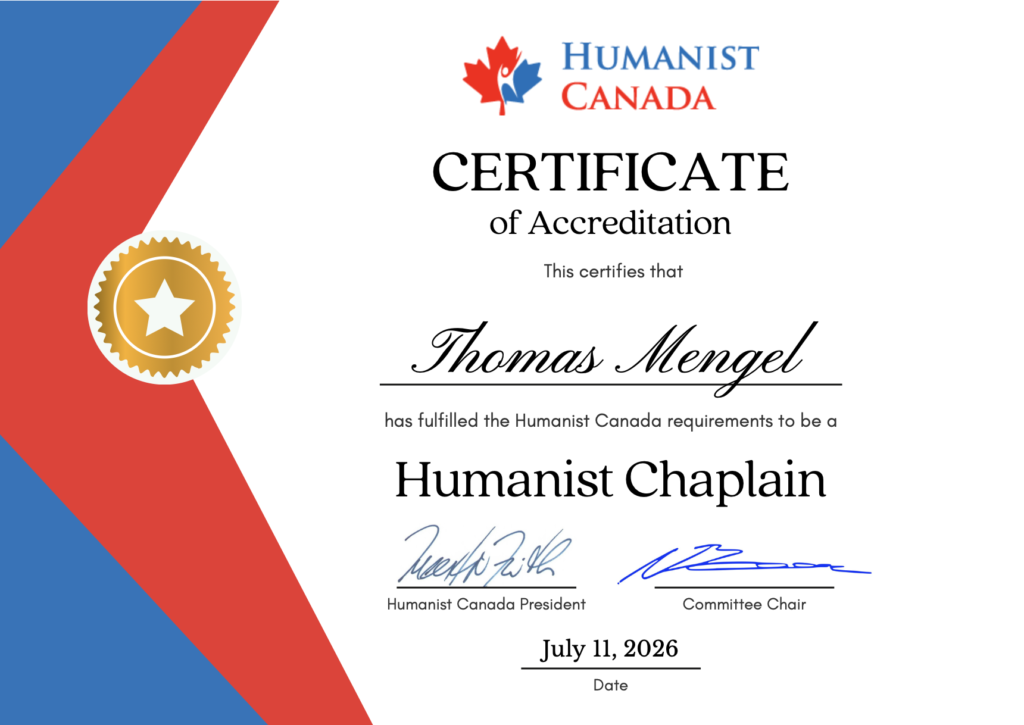
It means that after an intense year of trainings and assessments, and after a thorough review of my training in theology, pedagogy and psychology, philosophy and in logotherapy and existential analysis, of my references and relevant practical experiences, Humanist Canada certified my accreditation. That means that now I can serve as chaplain in any organizational setting in Canada that does offer existential and spiritual care to their constituents. Many are employed in the military, universities, penitentiaries, or in hospitals; many more are offering their services as volunteers.
The latter is where I fit in: After several years of volunteering already in the Nav-CARE program in the NL Health Services (NLHS) Department of Rehabilitation, Geriatrics, and Palliative Care, I will now also be a (volunteer) member of the Pastoral Care Team serving patients and clients of NLHS. Given that at least 20% of the NL population are not affiliated with any religious organization or faith, there finally is a non-religious option for pastoral care available to patients and clients if they so choose. This also widens, in a first step, the spectrum of pastoral care offerings given that these services are available to each and all patients and clients regardless of which religious or no faith they belong to.
I look forward to being an active member of an interfaith pastoral care team, which not only includes chaplains from various religious, Christian and non-Christian, backgrounds but now also has an advocate for the “nones”. Trained in pastoral theology, in existential care, and in humanist philosophy and practice, being with clients during difficult times and decision points, listening to them deeply, and companioning them on parts of their life journey feels to me like my life and my calling coming full circle…