Humanist Chaplain * Co-operative Community Developer * Life Celebrant * Retired Leadership Professor * Writer * Historian * Futurist * German-Canadian
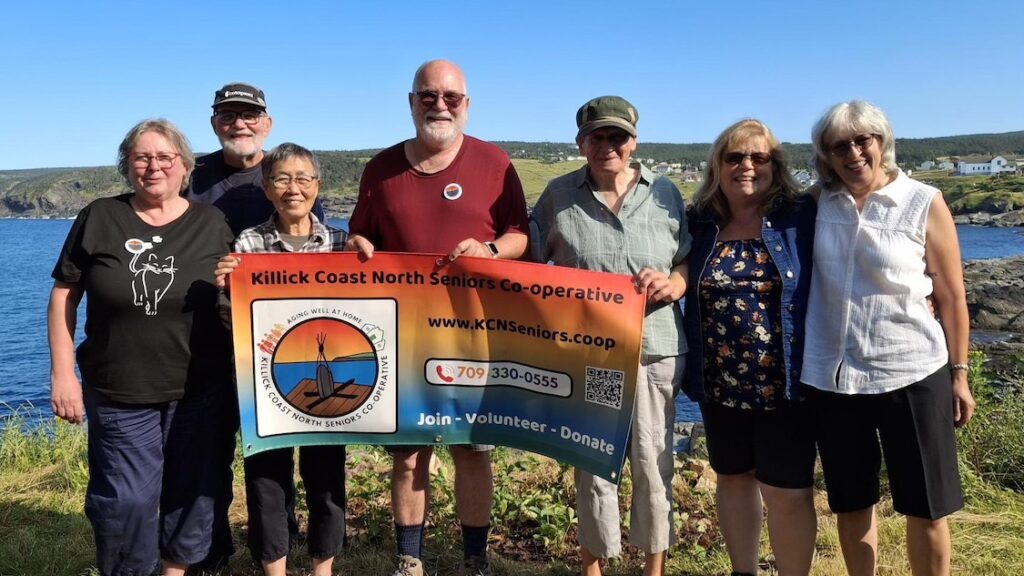
I am a leadership scholar and practitioner, co-operative community developer, humanist chaplain,certified life celebrant, anda writer. Based on Viktor Frankl’s approach to meaning and values oriented psychotherapy, I have developed the concept of Values-Oriented Leadership. In 2021, I published my research and many other perspectives in ‘Leadership for the Future: Lessons from the Past, Current Approaches, and Future Insights’. Newcastle upon Tyne, UK: Cambridge ScholarsPublishing.In recent years, I have written extensively about co-operative and values-oriented community development. In 2023 I retired from the University of NewBrunswick (Fredericton, Canada) and my wife Marion and I moved to Pouch Cove, Newfoundlandand Labrador. We cofounded the Killick Coast North Seniors Co-operative. I also serve on the board of the Sunrise Funeral Co-operative. Since 2025, I volunteer with NLHS ( Nav-CARE program, Palliative Care) and in July 2026 I have been accredited as Humanist Chaplain by Humanist Canada. If I am not volunteering, reading, or writing, I can be foundhiking or biking the East Coast Trail or the Coastal backroadson the Avalon Peninsula or exploring the rest of Newfoundlandand Labrador. More about me can be found under the various tabs on this website. Feel free to connect with me here.
My latest autobiographical essay has just been published in the fall issue of the Communities Magazine (#212 September 2026, pp. 66-69). The full essay is available here.
There is a particular kind of exhilaration that comes not from soaring, but from choosing to jump. —Søren Kierkegaard
I have jumped many times. I stumbled often. I hope to jump again. I have not always jumped with exhilaration or from solid ground. Some of my most important leaps began with a slow, private recognition that something essential had stopped working—a marriage that no longer provided the closeness I was yearning for, a faith whose beliefs no longer matched my understanding, a professional identity which has run its course. The jumping came later. First came the long, uncomfortable season of sensing or knowing that something is off…The full essay is available here.
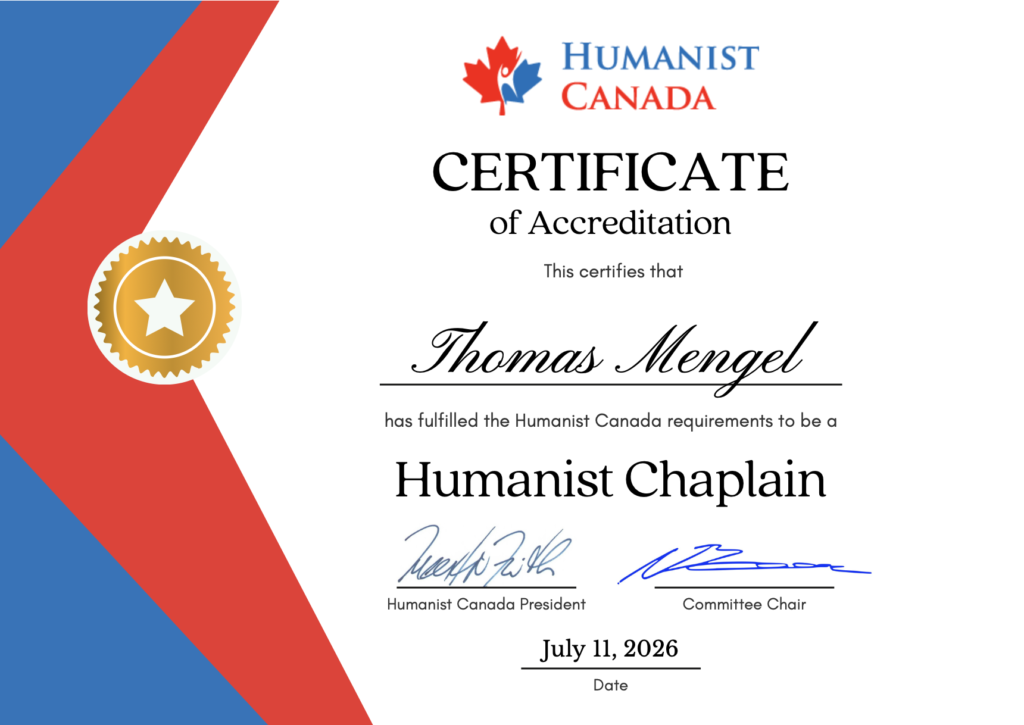
On July 11, 2026, I was accredited by Humanist Canada as Humanist Chaplain. At this point, I am the first and only humanist chaplain in the province. You may wonder: What does that mean? What does a humanist chaplain do?
It means that after an intense year of trainings and assessments, and after a thorough review of my training in theology, pedagogy and psychology, philosophy and in logotherapy and existential analysis, of my references and relevant practical experiences, Humanist Canada certified my accreditation. That means that now I can serve as chaplain in any organizational setting in Canada that does offer existential and spiritual care to their constituents. Many are employed in the military, universities, penitentiaries, or in hospitals; many more are offering their services as volunteers.
The latter is where I fit in: After several years of volunteering already in the Nav-CARE program in the NL Health Services (NLHS) Department of Rehabilitation, Geriatrics, and Palliative Care, I will now also be a (volunteer) member of the Pastoral Care Team serving patients and clients of NLHS. Given that at least 20% of the NL population are not affiliated with any religious organization or faith, there finally is a non-religious option for pastoral care available to patients and clients if they so choose. This also widens, in a first step, the spectrum of pastoral care offerings given that these services are available to each and all patients and clients regardless of which religious or no faith they belong to.
I look forward to being an active member of an interfaith pastoral care team, which not only includes chaplains from various religious, Christian and non-Christian, backgrounds but now also has an advocate for the “nones”. Trained in pastoral theology, in existential care, and in humanist philosophy and practice, being with clients during difficult times and decision points, listening to them deeply, and companioning them on parts of their life journey feels to me like my life and my calling coming full circle…
When the Catholic Church publishes a papal encyclical about ‘Magnificent Humanity’, a document warning against the Tower of Babel and calling for the patient, collective rebuilding of a just world, as humanists we might pause mid-scroll and think: that’s our argument.
When I, a former Catholic church historian, computer scientist, and leadership professor turned humanist chaplaincy candidate, read about the core value of human dignity in the context of AI, I suspect a common message.
Abstract***
Pope Leo XIV’s first encyclical, Magnifica Humanitas (May 2026), addresses artificial intelligence with unusual directness: it names algorithmic discrimination, surveillance capitalism, autonomous weapons, and technological unemployment as genuine moral crises, and insists that the response must be collective and democratic, it has to be centred on human dignity and the most vulnerable. Its social analysis is largely sound. Its ethical principles — dignity, solidarity, subsidiarity, the common good, the priority of the vulnerable — map closely onto the core commitments of the humanist tradition.
This article takes that convergence seriously. It argues that the encyclical’s strongest claims do not depend on theological foundations to stand — they depend on reason, evidence, and the accumulated moral experience of our species. A humanist rewriting of the document, retaining every substantive argument while replacing every load-bearing theological claim, produces not a curiosity but a genuinely useful and more universally accessible moral framework for AI governance.
The article then turns the exercise into a challenge. If humanists and the Catholic Church arrive at the same practical conclusions about AI — that technology must serve persons, that power must be accountable, that democratic governance is non-negotiable — humanists need to ask honestly whether they are making that case with sufficient urgency and clarity. Drawing on the encyclical’s central parable of Nehemiah’s wall — rebuilt not by a single authority but by all the people together, each tending their own section — the article proposes five concrete priorities for a humanist AI ethics and argues for a more collaborative, coalition-minded approach to the governance challenge ahead.
The conclusion is neither ecumenical capitulation nor sectarian point-scoring. It is an invitation: to take a good argument seriously wherever it appears, to make it better, and to make it louder.
* About this article
This article, and its supporting document, has been created with research and editorial assistance of Claude.AI. It draws on the full humanist rewrite of Magnifica Humanitas (Pope Leo XIV, 15 May 2026), in which all five chapters and the conclusion were reworked to ground the encyclical’s social-ethical analysis in shared human reason and solidarity rather than theological authority. The rewrite retained the document’s analytical framework and core ethical principles while replacing every load-bearing theological claim. The rewrite is available as a tracked-changes Word document (Follow this link for an executive summary of the rewrite).
** About the author
Dr. Thomas Mengel is a trained theologian with a focus on modern religious history and the sociology of religion. He also has graduate degrees in education, history, and computer science. More recently, he retired from his position as professor of interdisciplinary leadership studies (University of New Brunswick, Canada) and volunteers his time as cooperative community developer, and humanist chaplain candidate based in Pouch Cove, Newfoundland and Labrador, Canada. More about him and his writings can be found at thomasmengel.com.
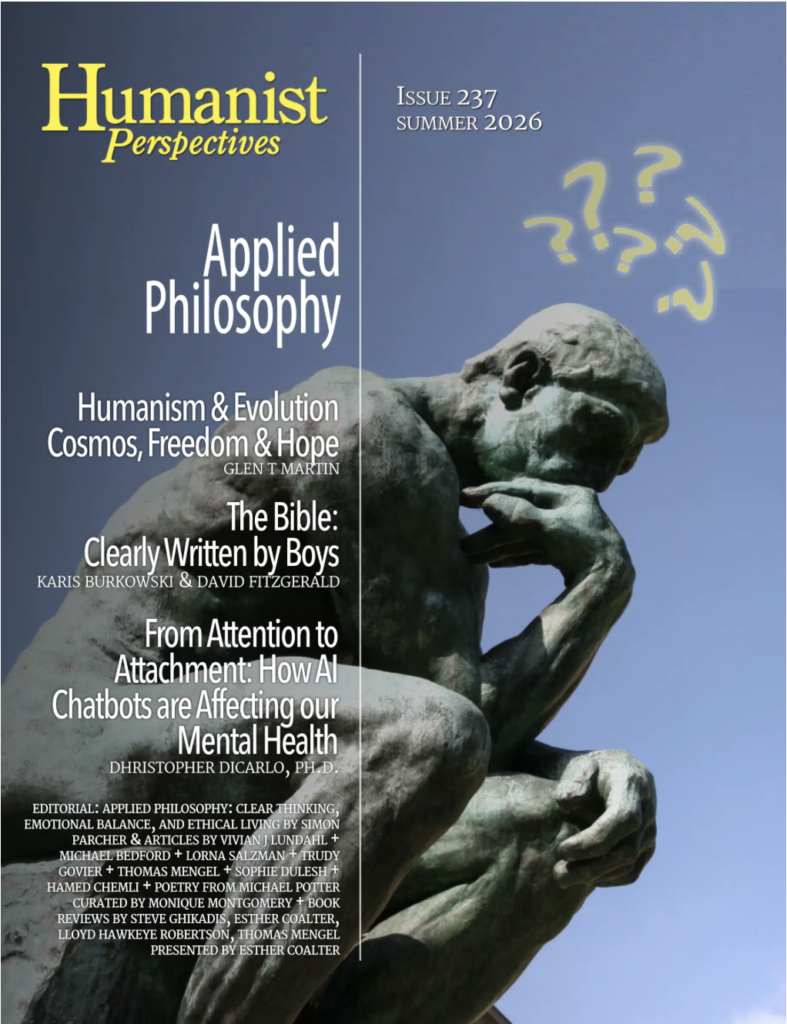
*** The complete article will be published in August in Humanist Perspectives, Issue 237, Summer 2026
My latest autobiographical essay has just been accepted for publication in the fall issue of the Communities Magazine (#212 September 2026). Here is a quick preview…
There is a particular kind of exhilaration that comes not from soaring, but from choosing to jump. —Søren Kierkegaard
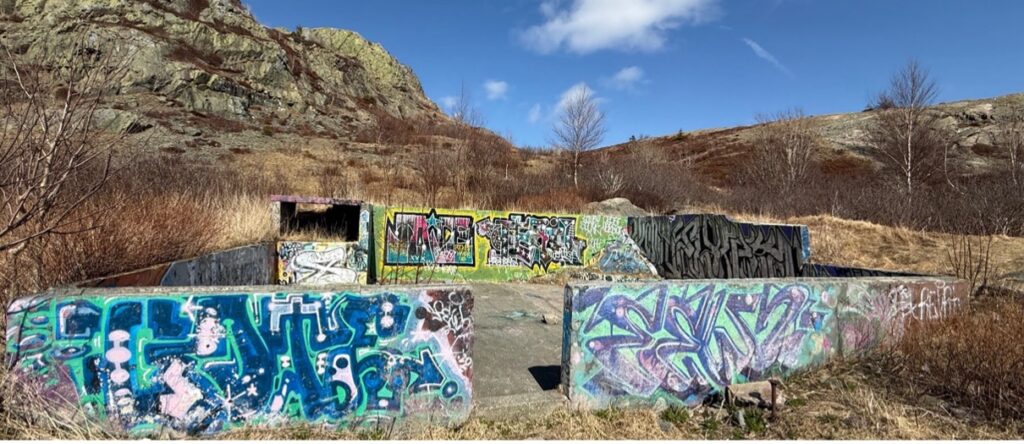
Photo 1: “Dizziness”, Signal Hill, St. John’s, NL (Photo: author)
I have jumped many times. I stumbled often. I hope to jump again.
I have not always jumped with exhilaration or from solid ground. Some of my most important leaps began with a slow, private recognition that something essential had stopped working—a marriage that no longer provided the closeness I was yearning for, a faith whose beliefs no longer matched my understanding, a professional identity which has run its course. The jumping came later. First came the long, uncomfortable season of sensing or knowing that something is off.
“Oxymoronic nonsense”, many will respond. “Why not”, others may ponder.
Rather than simply following the fear-mongers or faithful followers of Facebook and consorts, my reflection digs a little deeper and takes a broader sweep of my own and others’ experiences over the last sixty or so years, but yes, I am leaning towards a cautious “why not”. Here’s why…
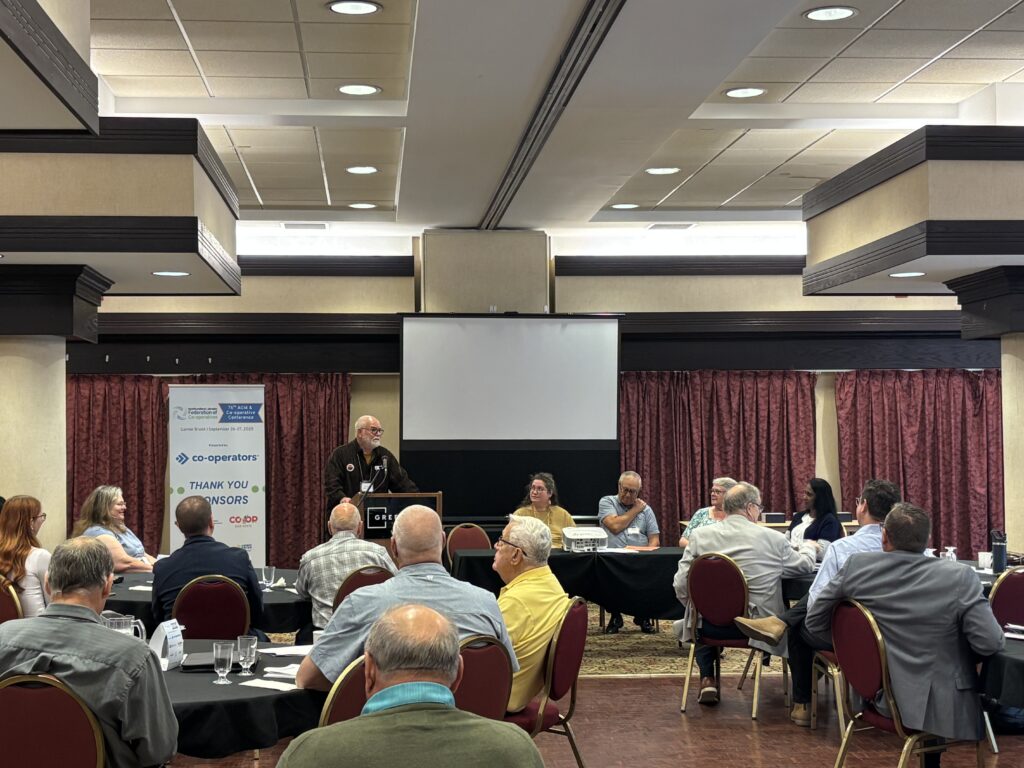
We had a blast driving across the rocky Island of Newfoundland, off the Atlantic Coast of Canada, to the 2025 Convention and AGM of the ‘NL Federation of Co-operatives (NLFC)’, September 26-27, 2025, in Corner Brook. Jimmy, Ken, and I, enjoyed each other’s company and we shared a deep love for the cooperatives we are part of. We were confident in contributing meaningfully to the cooperative movement, and we were hopeful for overcoming the setbacks we had just experienced in our own cooperatives….
…Love will not avoid conflict, but it will offer ways of peaceful and compassionate resolution of those conflicts, and it will allow cooperative communities to develop a strong and sustainable identity, based on enduring personal relationships, and building a sense of belonging and of being at home.
Read more here… An abbreviated version of this paper is in print for Communities, Issue 210, Spring 2026.
Following the nine day grief period a new pope will be elected from eligible cardinals in Rome. The upcoming conclave reminded me of a video I produced for the previous conclave in 2013 as part of my consulting company Reiss Profile Canada.
The video introduced an innovative approach to the papal election process that…well, see for yourself…unfortunately my slight hope that for the next conclave we might have an eligible female candidate did not materialize…again, see for yourself…